ABEDUL (Betula pendula Roth), hojas-corteza

Usos tradicionales:
a) uso interno: trastornos renales y de las vías urinarias; estados reumáticos y febriles; control de la diabetes mellitus insulinodependiente.
La infusión se prepara con 1 cucharada del vegetal para 1 litro de agua recién hervida: beber 1 taza 3 veces en el día.
b) uso externo: lavados de heridas infectadas, piel con comezón; previene la caída del cabello. Usar la misma infusión.
Efectos: diurético(1) , bactericida(2) de las vías urinarias, analgésico(3) , febrífugo(4) , hipoglicemiante(5) .
Precauciones: evitar su uso en casos de edema por disfunción cardiaca y falla renal. Por su contenido en salicilatos, no usar demasiado concentrado en pacientes con hemorragias activas o que estén siguiendo tratamientos con hemostáticos o anticoagulantes. Otros antecedentes: su uso como desinfectante del aparato urinario y como analgésico tiene alguna evidencia científica.
1 Promueve y aumenta la producción de orina.
2 Mata las bacterias o impide su desarrollo.
3 Disminuye el dolor.
4 Baja la fiebre.
5 Disminuye el nivel de azúcar en la sangre.
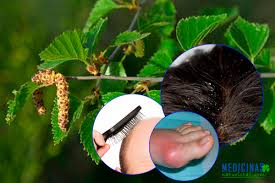
ABEDUL (Betula pendula Roth), leaves-bark
Traditional Uses:
A) internal use: renal and urinary tract disorders; Rheumatic and febrile conditions; Control of insulin-dependent diabetes mellitus.
The infusion is prepared with 1 tablespoon of the vegetable for 1 liter of freshly boiled water: drink 1 cup 3 times in the day.
B) external use: washes of infected wounds, itchy skin; Prevents hair loss. Use the same infusion.
Effects: diuretic (1), bactericidal (2) urinary tract, analgesic (3), febrifuge (4), hypoglycemic (5).
Precautions: avoid its use in cases of edema due to cardiac dysfunction and renal failure. Because of its content in salicylates, do not use too much concentrate in patients with active bleeding or who are following hemostatic or anticoagulant treatments. Other antecedents: its use as disinfectant of the urinary apparatus and as analgesic has some scientific evidence.

1 It promotes and increases the production of urine.
2 Kill the bacteria or prevent their development.
3 Reduces pain.
4 It lowers the fever.
5 It lowers the level of sugar in the blood.
ABEDUL (Betula pendula Roth), leaves-bark
Traditional Uses:
A) internal use: renal and urinary tract disorders; Rheumatic and febrile conditions; Control of insulin-dependent diabetes mellitus.
The infusion is prepared with 1 tablespoon of the vegetable for 1 liter of freshly boiled water: drink 1 cup 3 times in the day.
B) external use: washes of infected wounds, itchy skin; Prevents hair loss. Use the same infusion.
Effects: diuretic (1), bactericidal (2) urinary tract, analgesic (3), febrifuge (4), hypoglycemic (5).
Precautions: avoid its use in cases of edema due to cardiac dysfunction and renal failure. Because of its content in salicylates, do not use too much concentrate in patients with active bleeding or who are following hemostatic or anticoagulant treatments. Other antecedents: its use as disinfectant of the urinary apparatus and as analgesic has some scientific evidence.
1 It promotes and increases the production of urine.
2 Kill the bacteria or prevent their development.
3 Reduces pain.
4 It lowers the fever.
5 It lowers the level of sugar in the blood.


No hay comentarios.:
Publicar un comentario